A floor can have the right chemistry, the right installer and the right appearance target and still be put at risk if the slab moisture condition is misunderstood. The key is not to fear moisture—it is to measure the condition, understand the system limits and make the decision before installation pressure takes over.
Concrete moisture is a condition, not a visual inspection.
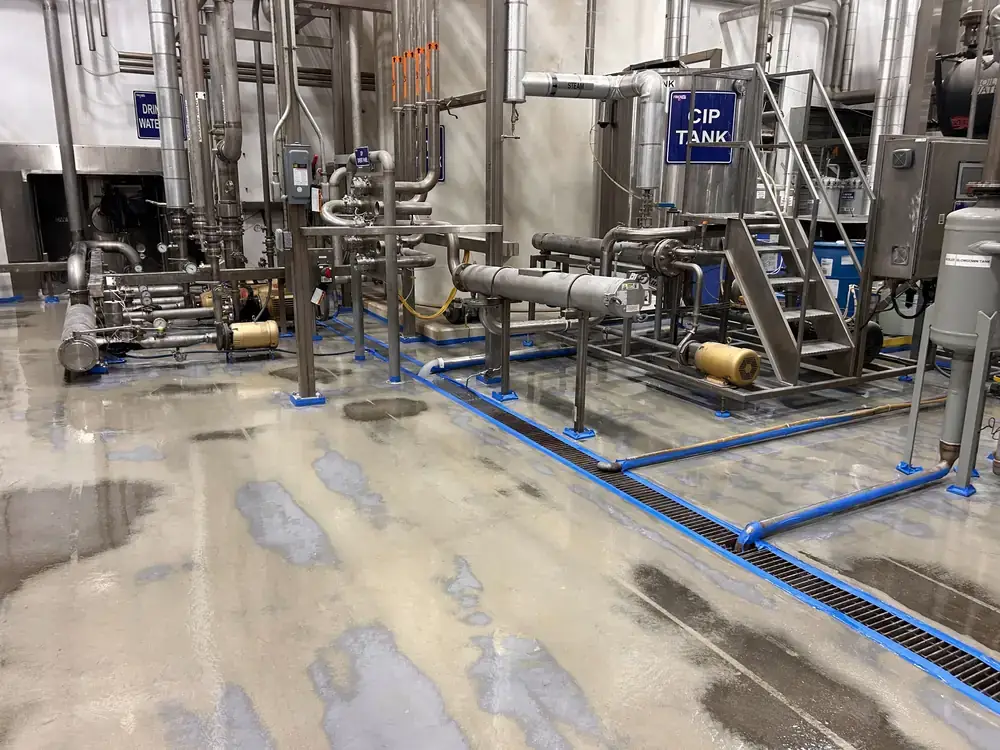
Concrete can contain and transmit moisture even when the surface looks dry. The amount of moisture present, the way it is moving, environmental conditions, slab construction and the floor system above it all influence risk. That is why “the slab looks dry” is not a useful acceptance standard for a moisture-sensitive coating.
For commercial work, the moisture discussion should connect the concrete condition to the flooring manufacturer’s published limits and the project specification. Testing is data for that decision—not a warranty by itself and not a substitute for understanding how the slab was built.
What testing can tell the project team.
Common project specifications use concrete-moisture test methods such as in-situ relative-humidity testing under ASTM F2170. Calcium-chloride testing under ASTM F1869 may also appear in specifications, subject to the current standard’s limitations and the flooring manufacturer’s requirements.
The important point is not simply which test is named. The project team needs to know what was tested, where it was tested, when it was tested, what the result means for the specified system and whether the environmental conditions during testing represent the planned installation condition.
The test result becomes useful when it is compared with the requirements of the actual primer, mitigation system, coating or other floor assembly being installed.
When elevated moisture changes the floor plan.
An elevated reading does not automatically mean the project cannot move forward. It means the system and responsibility need to be resolved. Depending on the specification, slab condition and manufacturer requirements, the response may involve an approved moisture-control system, a different primer or assembly, additional drying time, revised sequencing, or another design decision.
That decision should be coordinated before material is ordered and before the flooring crew is scheduled around a hard turnover date.
Questions worth resolving early
- What moisture test method and acceptance criteria does the specification require?
- What are the current limits for the exact flooring system being proposed?
- Is a vapor retarder present below the slab, and what is known about the slab construction?
- Are HVAC and building conditions representative of the planned installation environment?
- Who owns mitigation if the slab is outside the flooring-system limits?
- Will mitigation affect thickness, transitions, cure time, schedule or warranty requirements?
Moisture risk looks different for polished and coated floors.
A mechanically polished concrete floor and a low-permeability resinous floor do not interact with the slab in the same way. Polished concrete is not simply a “moisture solution,” and a resinous system is not automatically a “vapor barrier.” The correct approach depends on the complete assembly and the project conditions.
Resinous / Coated
Moisture compatibility, adhesion, primer selection, mitigation requirements and manufacturer limits need to be resolved before installation.
Polished Concrete
The slab itself becomes the finished surface, so moisture is considered alongside curing history, staining risk, contaminants and the desired final appearance.
The preconstruction goal: remove the surprise.
Moisture problems become expensive when they are discovered after the system, crew and turnover date are already committed. Diamond’s preferred approach is to identify the testing and responsibility requirements while the project still has room to make a good decision.
That can mean reviewing the flooring specification, concrete notes, finish schedule, slab history and manufacturer requirements together rather than treating moisture testing as an isolated closeout box.
This resource is general commercial-flooring guidance, not a substitute for the project specification, current ASTM requirements, manufacturer instructions or project-specific professional evaluation.