
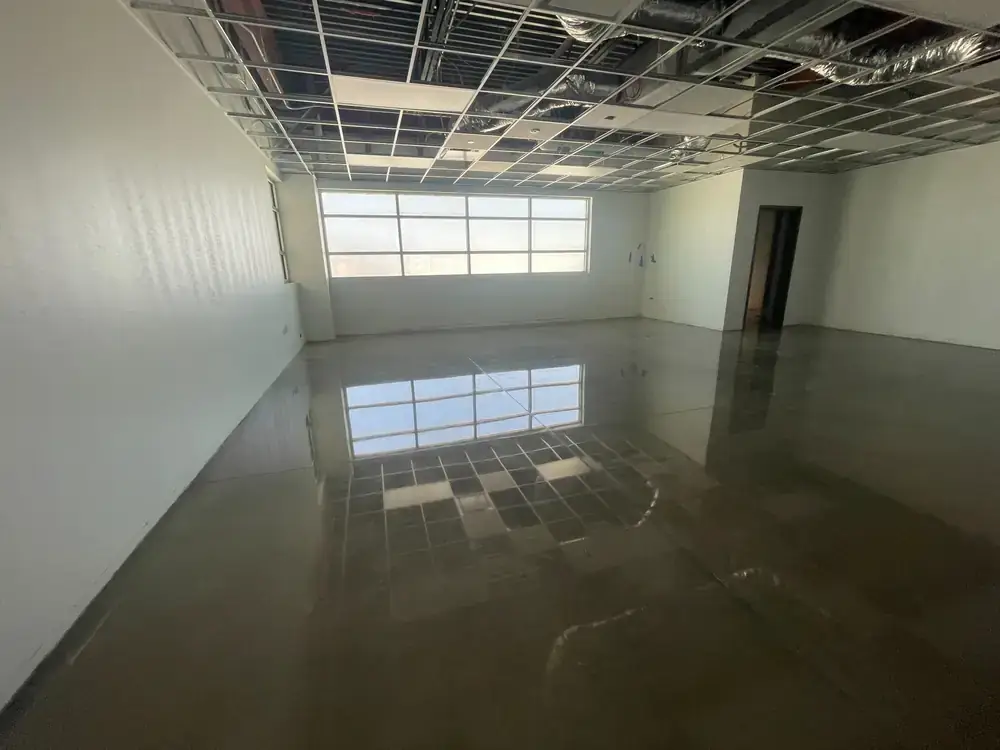
Eight years after the original installation, the owner did not need a new floor system. The goal was to recover more of the original clarity and gloss from a floor that had remained in service.
The original project
Diamond installed a stained and polished concrete floor in 2017. The work followed the full process required to create the intended finished surface: grinding and refinement, stain application, densification/polishing steps and protective treatment rather than treating polishing as a single cosmetic pass.
The facility then maintained the floor using the recommended cleaning approach. That matters because polished concrete performance is not created only during installation; it is affected by what happens to the surface every day afterward.
Build the floor as a process.
The original system was installed with the grinding, staining, refinement and protection sequence needed for the intended appearance and service.
Maintenance carries the result forward.
Routine cleaning and facility use changed the appearance over time, but the underlying floor remained a viable polished-concrete surface.
Renew instead of replace.
The floor was evaluated and refreshed to recover visual clarity and gloss rather than being demolished and replaced with a new flooring assembly.
The condition years later
By 2025, years of traffic and service had reduced some of the visual clarity and gloss the owner remembered from the original floor. That did not automatically mean the polished system had failed. The first question was whether the concrete and polished surface were still fundamentally serviceable.
That diagnosis changes the solution. A floor with ordinary wear and reduced clarity may be a restoration candidate. A floor with structural damage, severe contamination, deep staining or incompatible previous repairs may require a different path.
The project demonstrates one of polished concrete’s practical lifecycle advantages: when the slab and polished surface remain serviceable, appearance can sometimes be renewed through a planned restoration process.
Why the restoration path made sense
The original installation left something worth maintaining.
Grinding sequence, densification, stain application, edge work, final refinement and protection all affect how a polished floor behaves under traffic. Shortcuts can reduce what is available to recover later.
The owner’s maintenance history mattered.
Consistent particulate removal, appropriate cleaning chemistry and reasonable spill response help preserve the surface. Maintenance cannot fix poor installation, but good installation can also be undermined by poor maintenance.
The team diagnosed the floor before prescribing the fix.
Restoration should begin with the actual floor condition, not a predetermined treatment. Existing gloss, scratching, staining, repairs, traffic patterns and owner expectations all influence the work required.
What this project proves—and what it does not
This project does not guarantee that every polished floor will perform the same way for eight years or that every older polished floor can be restored. Slab condition, use, maintenance and the original process vary from project to project.
What it does demonstrate is the value of thinking about lifecycle during the original installation. A commercial floor can be a maintainable asset rather than a finish that is treated as disposable when the appearance changes.
This case study is based on Diamond’s previously published account of the original 2017 installation and the restoration documented in 2025. The customer/facility is intentionally not identified here, and no performance guarantee for other slabs or environments is implied.