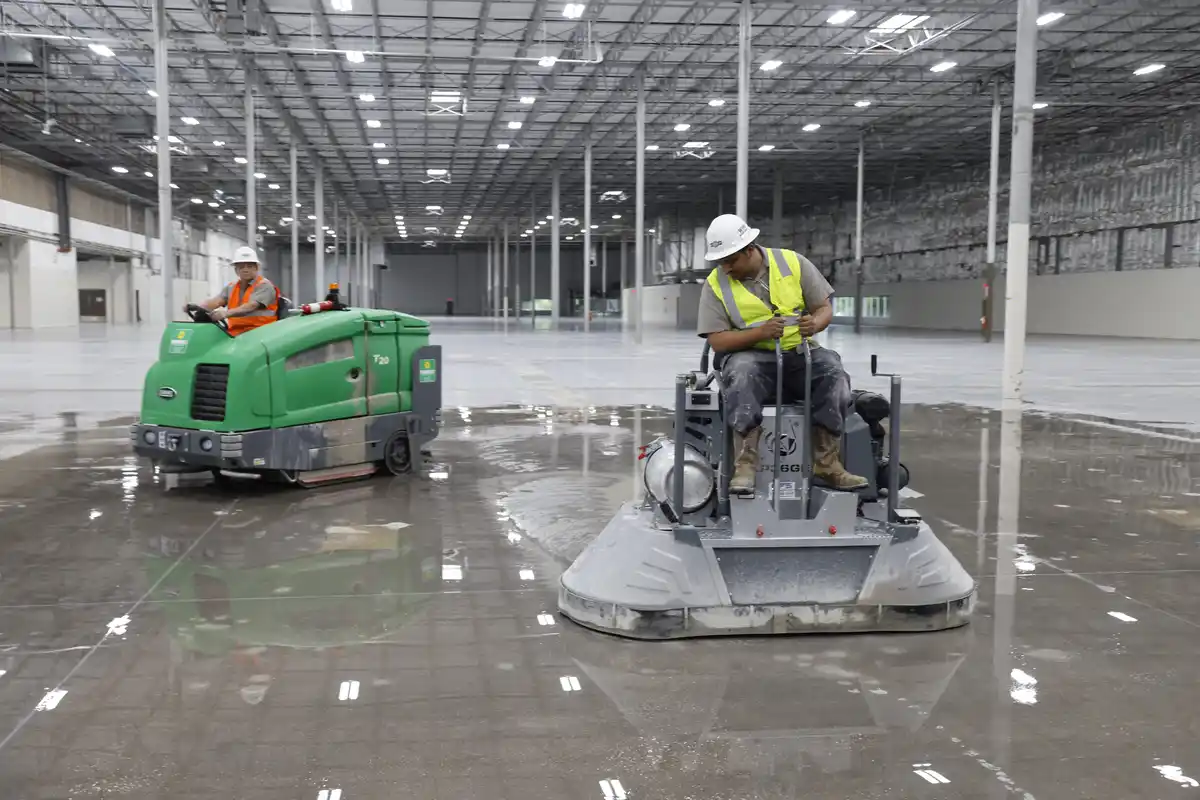
The polishing work did not begin with refinement. It began by getting back to a slab that could actually be processed: remove the existing coating, repair the surface, establish the first grind, then move through the polishing sequence.
The project condition
The approximately 120,000-square-foot warehouse floor had an existing coating that had to be removed before the concrete could become the finished surface. Surface repairs were also part of the scope, which meant the final appearance depended on more than running polishing equipment across an open slab.
On rehabilitation work, the condition uncovered after removal becomes part of the floor. Repairs, previous coating residue and surface variation have to be addressed before refinement can produce a consistent warehouse-use finish.
Take the existing coating off the slab.
Coating removal opened the concrete so the underlying condition could be addressed and the polishing process could begin from the actual substrate.
Correct the surface before refinement.
Surface repair was completed as part of the rehabilitation scope rather than treating defects as something polishing alone would hide.
Establish the floor with 70-grit metal-bond tooling.
The polishing sequence began with 70-grit metal-bond grinding to establish the working surface before moving into finer refinement.
Progress through resin-bond tooling to 400 grit.
The floor was refined through the polishing sequence to a 400-grit resin finish suited to the intended warehouse application.
Densifier and guard complete the system.
Densifier and guard were applied as part of the final polished-concrete treatment for the warehouse service environment.
Why this is a rehabilitation project—not just a polishing project
Large existing slabs bring a different set of decisions than new concrete. Coating removal changes production. Repairs change visual consistency. The starting profile determines what tooling follows. And every phase has to move across a large floor without losing control of the final finish.
That is why Diamond treats coating removal, substrate repair and polishing as one connected floor strategy when they belong to the same outcome.
The project moved from coating removal and substrate correction through a defined 70-metal-to-400-resin polishing sequence, then densifier and guard for the intended warehouse-style use.
What this project demonstrates
Preparation is part of the finished floor.
The final polishing result depends on what is left after the existing coating comes off. Surface defects and repair needs have to be handled as part of the system, not treated as separate cleanup work.
The sequence matters at scale.
A 120,000-square-foot floor magnifies inconsistency. The tooling progression has to be repeatable across the slab so the finish is produced by process rather than isolated good areas.
Warehouse floors need a service-minded finish.
The selected refinement level, densifier and guard were part of a floor build intended for warehouse-style use rather than an architectural finish selected only for appearance.
This case study uses verified Diamond project facts supplied for this project: approximately 120,000 SF, existing coating removal, surface repair, 70-grit metal-bond grinding through 400-grit resin refinement, densifier and guard. Customer, location, schedule and other project metrics are intentionally omitted where not verified for publication.